
Orbital Sunrise · Voskhod‑2 · 19 March 1965
Orbital Trajectory Reconstruction
the calculations inside Leonov's mind, an estimate
For viewers of Orbital Sunrise. A “klick” is soldier’s slang for a kilometre, so the song says Voskhod 2 came down about 1,500 km from where it should have. 1500 km is from Leonov's memoirs. But it measures something different from where the capsule finally came down.
1Why we did the math
The song is told from inside Leonov’s head, in the minutes after the automatics failed, when he had to work out by hand where they would come down. How far off did Alexei Leonov and Pavel Belyayev actually land in March 1965? And how much of the miss came from two men doing by hand what a machine was supposed to do?
To do this, it seemed simpler to just model the trajectory of the spacecraft from publicly available sources.
2How we sourced the figures
Every number below carries one of three labels:
- DocumentedIt is in a source we can point to.
- EstimateOur own calculation from documented inputs. Nobody in 1965 wrote it down.
- Our inferenceA reading of the sources that seems the most likely to us, but that no source states outright.
What kinds of sources
- Spacecraft data: engine thrust, orbit, capsule size and weight, mostly from Wikipedia pages that cite the standard NASA history (Asif Siddiqi, Challenge to Apollo, NASA SP-2000-4408).
- Mission accounts: Anatoly Zak’s RussianSpaceWeb history of the landing, read in full.
- Memoir: Leonov’s own article “The Nightmare of Voskhod 2” (Air & Space, January 2005), adapted from his book Two Sides of the Moon, also read in full.
- Reanalysis weather: ERA5, a modern computer reconstruction of past weather (a model, not a measurement). It rebuilds the weather hour by hour, anywhere on Earth, going back to 1940, which is why we could look up the afternoon of 19 March 1965 at the landing site.
When sources disagree
The rule is to be accurate. Where honest accounts genuinely differ (Leonov’s memory against the official record, say), the film may keep the more dramatic version, and the notes say so. Anything no source supports gets fixed.
The main sources
| Source | What we used it for |
|---|---|
| Leonov, “The Nightmare of Voskhod 2”, Air & Space, 2005 | The crew’s view: the failure, the 1,500 km forecast, the cabin |
| Zak, “Voskhod-2 lands in the wild”, RussianSpaceWeb | Burn times, the “800+ km” overflight, the landing site |
| Wikipedia, “Voskhod 2” and “Voskhod (spacecraft)” | Orbit, engine, capsule, parachutes, the 46 s and 386 km (citing Siddiqi) |
| Russian Wikipedia, “Восход-2” | Planned landing zone, −19 °C and 1.5–2 m of snow |
| Spacefacts, Sven Grahn, Astronautix | Cross-checks; the cause of the sensor failure |
| ERA5 (Copernicus) via the Open-Meteo archive | Wind, temperature and snow at the landing site |
Some of these pages we could only see as search excerpts; the detailed working notes say which.
3Inside the capsule: what they knew and what they had to work out
The failure. On 19 March 1965, the day after the spacewalk, the ship was due to point itself backwards and fire its braking rocket on its own. Leonov noticed “just five minutes before” that the automatic system wasn’t working Documented. The likely cause was the Sun sensor the ship used to find its orientation; one account says gas from the explosive bolts that dropped the airlock had fogged it Documented (as a secondary account). Without it, the ship could not tell which way was “backwards”.
The new plan. They would land by hand, one orbit later. Belyayev told the ground:
“We can make only one attempt at reentry.”Pavel Belyayev Documented
One orbit took 90.9 minutes.
Pointing the ship by eye. The tool was the Vzor, a periscope sight looking down through a porthole in the floor. It had a ring of small windows round a central view. Belyayev would level the ship until the horizon showed evenly in all the ring windows, then turn it until the ground below “flowed” along the guide lines. Then the ship was lined up with its path. It only worked over the daylit side of the Earth.
The awkward cabin. Voskhod was a Vostok capsule rebuilt for more crew, and the seats sat crosswise to the sight. In Leonov’s words, Belyayev “had to lean horizontally across both seats in the spacecraft, while I held him steady in front of the orientation porthole.” Then: “We then had to maneuver ourselves back into the correct positions in our seats very rapidly so that the spacecraft’s center of gravity was correct during the reentry burn” Documented. Their bodies were part of the ship’s balance.
What they could not know. No satellite navigation, no live position fix. They had a clock, the known orbit, a small turning globe on the panel (the Globus) and the ground’s instructions. Leonov, “as navigator”, picked the landing area: “an area close to the city of Perm” Documented.
Where “1,500 km” comes from
Leonov wrote that they knew they “would be coming down off-target—1,500 kilometers west of where we were supposed to land” Documented. That was said before the burn. Here is a back-of-envelope way a cosmonaut could get that number. This is our reconstruction, not something the crew wrote down.
A spacecraft’s path doesn’t change much from one lap to the next, but the Earth turns underneath it. So each lap crosses the ground further west.
That is “1,500 kilometres west”, near enough (the detailed notes, with more decimals, get 1,535 km). Notice what it measures: not a miss, but how far the whole path moved by waiting one lap.
4Working backwards: what we know now
With hindsight we can do what the crew couldn’t: start from where they landed and ask what happened.
Where they landed Documented. In deep snow in the taiga, about 180 km north of Perm, at roughly 59°34′N 55°28′E, around 12:02–12:06 Moscow time (sources differ by 4 minutes).
How far off. Flight-data accounts give 368 or 386 km beyond the aim point on the new orbit Documented. RussianSpaceWeb gives “more than 800 km” past the planned landing area, probably the original zone in Kazakhstan; Kustanay to the landing site is about 865 km by our check Estimate.
The late burn. The manual firing was planned for 11:35:44 Moscow time; Wikipedia gives 11:36:27 as the actual time. That is 43 seconds late. The often-quoted figure is 46 seconds for Belyayev to get back to his seat (from Siddiqi via Wikipedia; it is in neither of the two full texts we read).
How much does a late burn cost? A burn made late simply happens further along the path, and the whole descent slides forward with it. The point on the ground under the ship moves at about 7.4 km every second (a bit slower than the ship’s own 7.5–7.9 km/s, because the ship is a few hundred km up). So:
That covers most of the 368–386 km Estimate.
The often-quoted 46 s delay.
How sensitive is the landing?
We ran a simple model of a falling ball through a standard atmosphere. It gives sizes, not answers Estimate. The key finding: Voskhod comes in very shallow, only about 1.5–2.5° below horizontal at 100 km, and a shallow entry stretches small errors into big ones.
| What goes wrong at the burn | How far the landing moves |
|---|---|
| Burn 1 s late | about 7.4 km further on |
| Burn gives 1 m/s too little push | 40 to 95 km further on |
| Thrust tilted 1° up or down | 50 to 80 km either way |
| Thrust tilted 3–5° nose-up | 150 to 450 km further on |
| Thrust turned 3° sideways | tens of km to the side |
| Upper air 20% thinner or thicker | 30 to 70 km |
| Parachute drift in the wind | 2 to 6 km |
RussianSpaceWeb says both men were “apparently out of their seats” when Belyayev pressed the ignition button, so the ship’s balance was off and it flew a shallower path than planned Documented. A few degrees of tilt would be enough to stretch a 340 km miss toward 800 km. How many degrees it really was, we can’t say.
The spin came later. After the burn a cable kept the cabin joined to the equipment section, and the pair whirled until about 100 km up Documented. The air up there is too thin for the tumble to change the path much Estimate. It cost blood vessels, not kilometres.
The weather (from ERA5, our retrieval)
ERA5 reconstructs the weather hour by hour, anywhere on Earth, back to 1940; it is a model reconstruction, not a measurement. At noon on 19 March 1965, at the grid point nearest the landing site:
| Item | ERA5 value |
|---|---|
| Wind at 10 m | 4.0 m/s from the south-west (gusts 9.5 m/s) |
| Wind at 100 m | 6.1 m/s from the south-west |
| Temperature | −1.1 °C, falling to about −4 °C by dawn on the 20th |
| Cloud | Overcast all day |
| Snow depth | 0.66 m (average over a ~30 km grid cell) |
Russian Wikipedia says −19 °C and 1.5–2 m of snow; Leonov wrote of “two meters of thick snow”. ERA5 for 1965 has few Ural weather stations to anchor it and averages over a wide area, and drifts in forest clearings run far deeper than the average. We don’t pick a side: the film keeps the deep snow and the cold, and the notes say what the data says.
Parachutes and drift
One Wikipedia page puts the start of the parachute sequence at about 5 km up; another puts the main parachute at about 2.5 km. We read these as two stages, a small braking chute (a “drogue”) first and then the main canopy, rather than a contradiction Our inference (we have no primary source for the timing). The film’s card now reads MAIN PARACHUTE — OPEN · ALTITUDE ~2.5 KM.
The drift, step by step Estimate, with assumed winds aloft of 7–15 m/s:
So the wind carried them about 2–6 km to the north-east. The wind chose the clearing, not the district.
Their knowledge against ours
| In the capsule, 1965 | With hindsight | |
|---|---|---|
| Where they’d land | “1,500 km west” of the old zone; “near Perm” | 180 km N of Perm, ~368–386 km past the new aim |
| Why | One extra lap, Earth turning underneath | Plus a ~43–46 s late burn and an off-balance ship |
| Weather | Unknown | Light SW wind, overcast, around freezing (ERA5) |
| Where they actually were | The instruments said 2,000 km beyond Perm | They weren’t |
5The human hand: timing by squeeze and button
What was done by hand Documented. Pointing the ship (Belyayev, with the hand controller and the Vzor), choosing the landing area (Leonov), and starting the engine: RussianSpaceWeb says Belyayev “pressed the ignition button”. Leonov wrote that they had to “decide on the exact timing and duration of the retro-rocket firing”.
What is unclear. Our sources do not say how the burn was stopped: whether the ship’s own system cut the engine once it had given enough push, or whether a crewman did. RussianSpaceWeb says only that the burn “apparently lasted as scheduled”. So below we show both cases.
Reaction time Estimate (general, not from the Voskhod sources). A rested person pressing a button on a cue takes about 0.2–0.3 s; more under stress, in thick gloves and a pressurised suit (they landed in their Berkut suits). Call it 0.2 to 1 second.
Starting late or early
Each second costs about 7.4 km along the path:
| Timing error at ignition | Landing shift |
|---|---|
| 0.2 s | about 1.5 km |
| 0.3 s | about 2.2 km |
| 1 s | about 7.4 km |
| 5 s | about 37 km |
| 43–46 s (the actual delay) | about 320–340 km |
You might expect re-entry to magnify a timing error. In our model it doesn’t: a late burn just slides the whole descent forward at ground-track speed. The magnifying happens with the size and direction of the push, below.
Stopping late or early
Only if a person stopped it Estimate. The engine’s 15.8 kN thrust on a 5.7-tonne ship gives:
| Cut-off error | Push missing | Landing shift |
|---|---|---|
| 0.2 s | about 0.6 m/s | about 20–50 km |
| 0.3 s | about 0.8 m/s | about 35–80 km |
| 0.5 s | about 1.4 m/s | about 55–130 km |
If the ship cut its own engine, these errors mostly disappear.
Holding the ship straight by hand
Estimate Pointing by eye through a periscope is good to a degree or two, perhaps a few. Two separate effects:
The honest conclusion
A good hand on the button costs a few km. Even a clumsy one, a second or so, costs under 10 km. If a person also had to cut the engine, a few tenths of a second there could cost tens of km. A few degrees of tilt could cost hundreds. But the big, documented error is the 43–46 second delay while two men in spacesuits untangled themselves from the sight and got back into their seats. That, plus the ship flying off-balance, is what turned a planned landing into a few hundred kilometres of taiga.
6Learnings along the way
Things we got wrong in our own first drafts of the video and of this page, and what changed.
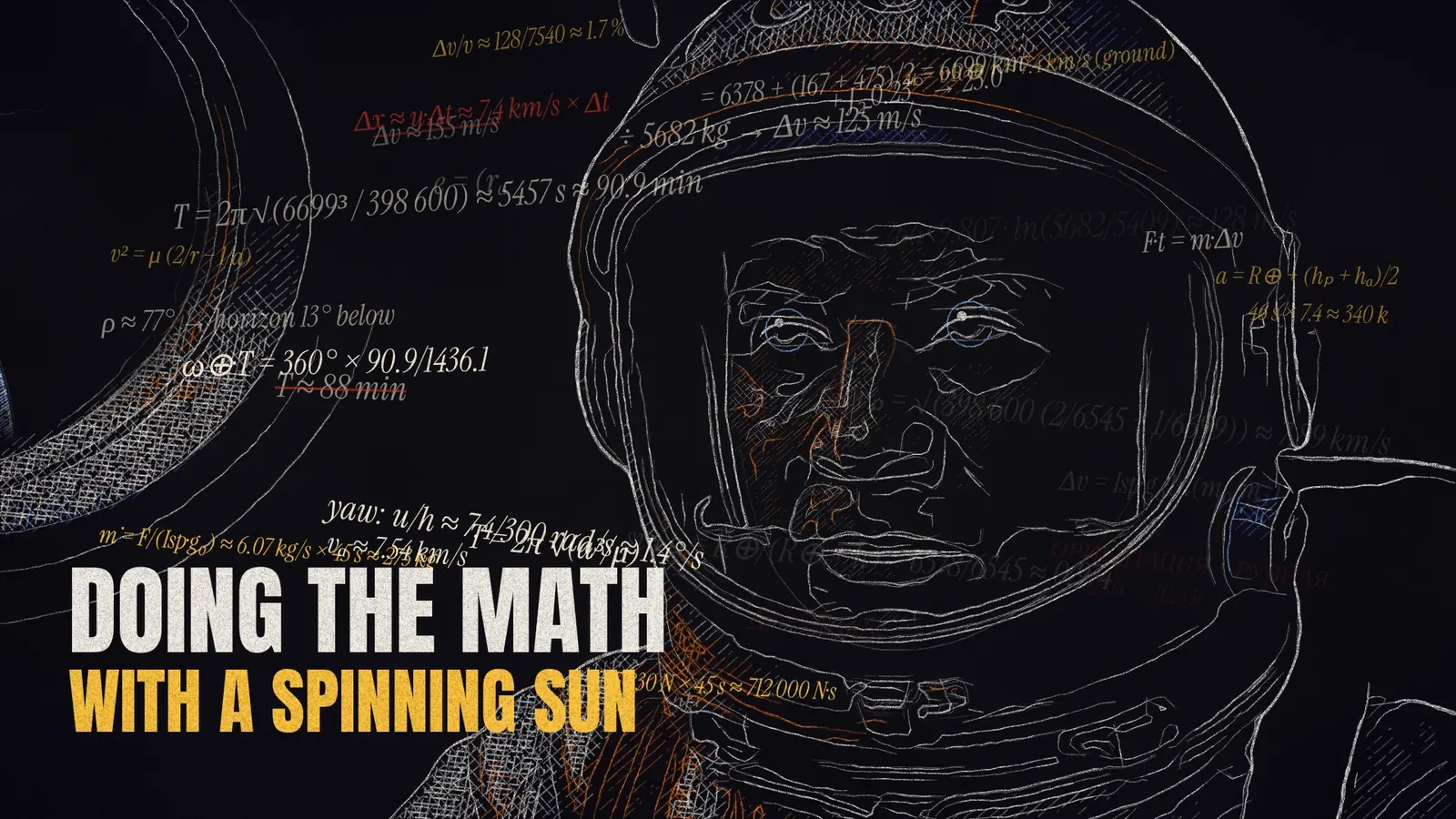
- The engine’s push came from the wrong ship. Our first draft of the ring of equations that fills the screen while Leonov does the math said Δv ≈ 155 m/s, Wikipedia’s figure. That only works for Vostok’s weight (4,725 kg); with Voskhod’s 5,682 kg it is about 125–130 m/s, so the on-screen math now writes 155, crosses it out and lands on about 130.
- Invented numbers in the on-screen equations. Before that, the same ring of equations showed “Δv = 106 m/s · t = 22 s · h = 497 km · ±1°”, which matched neither the engine nor the orbit. We replaced them with sourced figures.
- “Altitude ~500 km” was the high point. Our first draft of the video labelled the orbit ALTITUDE ~500 KM, but the orbit ran from 167 to 475 km. The caption now says APOGEE (the highest point) ~500 KM.
- Ship speed vs ground speed. Our first draft of this math multiplied the 46 s delay by the ship’s 7.8 km/s and got about 360 km. The point on the ground beneath it moves slower, about 7.4 km/s, so the answer is about 340 km.
- The 46 seconds. Our first draft treated “46 s to get back to his seat” as solid. Neither full account we read contains it, and the clock times give 43 s, so we now mark 46 s as second-hand.
- The weather we thought we couldn’t get. Our first draft said there was no wind record, because our tools couldn’t reach ERA5, the archive that reconstructs the weather hour by hour, anywhere on Earth, back to 1940 (a model, not a measurement). Once the songwriter retrieved the afternoon of 19 March 1965 at the landing site, the wind proved light and steady, worth only a few km of drift.
- One parachute or two? Our first draft had the main parachute opening at 5 km, giving 3.5–9.5 km of drift. The two published heights (5 and 2.5 km) fit a small braking chute followed by the main one, so drift fell to 2–6 km and the on-screen caption changed from 5 KM to ~2.5 KM.
- The Russian failure caption. Our first draft of the video labelled the failure ОТКАЗ АВТОМАТИКИ (“automatics failure”). A native speaker preferred ОТКАЗ СИСТЕМЫ УПРАВЛЕНИЯ (“control system failure”), and the video now uses it.
- “1,500 km” is a forecast, not a miss. Our first draft read Leonov’s figure as an exaggerated overshoot. In his full article it is his prediction before the burn, and it matches one lap’s westward shift almost exactly.
7Where the song’s number lands
The capsule came down a few hundred kilometres past its new aim: 368–386 km by the flight data, more than 800 km from the original zone by another count. Not 1,500.
But 1,500 km is not made up. It is the number Leonov wrote down for the moment the automatics failed: the two of them, five minutes before the planned burn, realising they would have to wait a lap and come down far to the west. It is the math they did in their heads, and it is very nearly right for what it measured.
That is what the song is about: what was going through Leonov’s head in those minutes, the sums and the reasoning, with too little to go on and only one try. This page is how we worked backwards to what was in his mind then.
The lyric’s 1,500 km is his forecast, made with what he knew at that moment. Our hindsight numbers don’t correct it; they explain it.